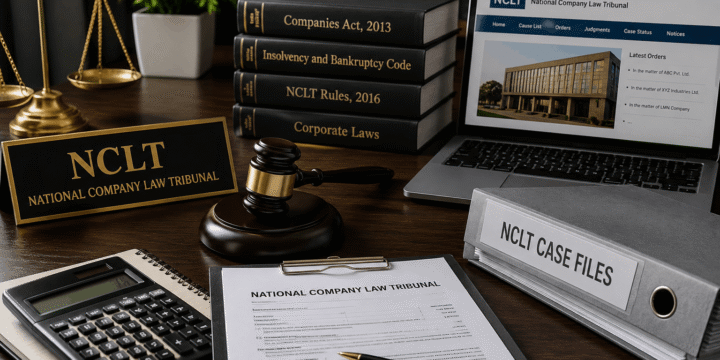
NCLT (National Company Law Tribunal): Role, Functions, and Legal Importance in India

NCLT (National Company Law Tribunal): Role, Functions, and Legal Importance in India

Blogs
The National Company Law Tribunal (NCLT) is a specialized quasi-judicial body established by the Government of India to adjudicate matters relating to companies and corporate entities. It plays a crucial role in resolving corporate disputes, insolvency proceedings, mergers and acquisitions, shareholder conflicts, oppression and mismanagement cases, and various issues arising under company law. NCLT has significantly transformed India's corporate legal framework by providing a dedicated platform for efficient resolution of company-related disputes. Established under the provisions of the Companies Act, 2013, NCLT functions as an independent tribunal with powers similar to a civil court in matters related to corporate governance and insolvency. It works alongside the National Company Law Appellate Tribunal, which hears appeals against NCLT orders. What is NCLT? The National Company Law Tribunal is a specialized judicial authority…

Read More
NCLT Insights: Insolvency, Litigation & Business Protection

NCLT Insights: Insolvency, Litigation & Business Protection

Blogs
The National Company Law Tribunal (NCLT) has become the central authority for resolving company-related disputes in India. Whether it is insolvency, business distress, shareholder conflict, or corporate restructuring, NCLT plays a crucial role in safeguarding businesses and ensuring transparent legal processes. For companies, professionals, and stakeholders, understanding NCLT procedures has become essential. 1. The Role of NCLT in Corporate India NCLT is a quasi-judicial body that handles matters related to: Insolvency & Bankruptcy (IBC cases) Company law disputes Oppression & mismanagement Mergers, amalgamations & restructuring Shareholder protection Corporate governance issues Its purpose is to offer fast, specialized, and predictable justice in business matters. 2. Insolvency Matters: When a Business Faces Financial Stress Under the Insolvency and Bankruptcy Code (IBC), NCLT acts as the adjudicating authority. Insolvency cases include: a. Corporate…
Read More
Money, Manipulation, and Misconduct: Inside White-Collar Crimes

Money, Manipulation, and Misconduct: Inside White-Collar Crimes

Blogs
White-collar crimes represent a sophisticated form of criminal activity that thrives in the corporate and financial world. Unlike traditional crimes, these offenses are committed through deceit, manipulation, and breach of trust rather than physical force. They are often perpetrated by professionals, executives, and individuals in positions of authority who exploit systems for personal or organizational gain. At the heart of white-collar crime lies financial motivation—money drives manipulation. Fraudulent schemes such as embezzlement, insider trading, money laundering, and corporate fraud are designed to manipulate financial records, deceive investors, or mislead regulatory bodies. These crimes not only result in enormous financial losses but also erode public trust in institutions and the justice system. One of the major challenges in addressing white-collar crime is its complexity. The offenders often use sophisticated techniques and…
Read More
Decoding Deception: Navigating the Realm of White Collar Crime Law

Decoding Deception: Navigating the Realm of White Collar Crime Law

Blogs
White Collar Crime has emerged as one of the most complex and challenging aspects of modern legal practice. Unlike traditional crimes that rely on physical force or violence, white collar crimes are typically committed in professional and corporate environments, involving deceit, fraud, and manipulation for financial gain. These offenses undermine the integrity of businesses, financial institutions, and governance systems, making them a major concern for both regulators and the judiciary. Understanding White Collar Crimes The term “white collar crime” was first coined by sociologist Edwin Sutherland in 1939, referring to crimes committed by professionals in positions of trust. These crimes are non-violent but highly damaging, often causing economic instability and loss of public confidence in institutions. Common examples include: Corporate Fraud – Misrepresentation of financial statements, insider trading, and falsification…
Read More